

A brief look at the operating principle
An RCM (Residual Current Monitor) monitors residual current and signals when response values are exceeded. RCD (Residual Current Device) is the generic term for residual current protective devices, which disconnect the circuit under their protective operating conditions. An RCM's monitoring and alarm function does not replace the protective function of an RCD.
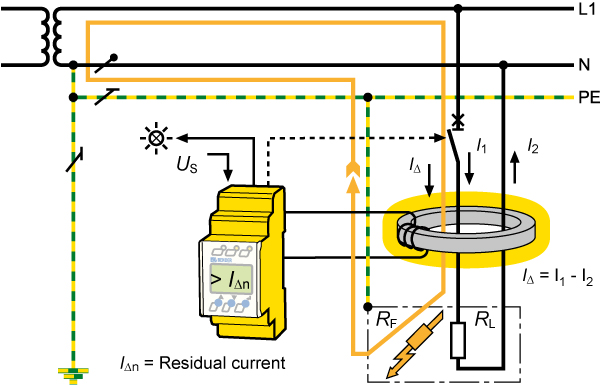
What do RCM, RCMS and RCD mean?
These abbreviations identify a device’s measurement, multichannel monitoring or protective function.
- RCM — Residual Current Monitor: A device that measures residual current and signals when response values are exceeded.
- RCMS — Residual Current Monitoring System: A multichannel residual current monitoring system. RCMS products monitor multiple outgoing circuits using compatible sensors; the number of channels depends on the model.
- RCD — Residual Current Device: A residual current protective device that disconnects the circuit under its protective operating conditions.
Why is the sum of currents measured?
All live conductors of the monitored outgoing circuit pass together through the same measuring current transformer. Protective conductor PE remains outside the loop. In the ideal case with no leakage or fault current, the sum of the currents in the live conductors is zero. If part of the current returns via PE or another path, the sensor detects the difference. The RCM displays measured residual current and generates information when the configured threshold is exceeded. Multichannel RCMS systems monitor different outgoing circuits separately.
Giving an alarm and tripping for protection are different tasks
An RCD disconnects the circuit as part of its intended protective function. An RCM supports continuous monitoring of electrical condition and early detection of deterioration. Depending on the model and wiring, an RCM's relay outputs may be used for signalling or switching; this does not give the RCM an RCD protective function. MRCD protection is assessed using the device, sensor and circuit-breaker combination verified by the manufacturer. Considering monitoring thresholds alongside protective device behaviour can give the maintenance team earlier, clearer information.
The waveform changes sensor selection
In loads containing power electronics, residual current may include more than the mains-frequency AC component. Pulsating or smooth DC components and different frequencies require suitable detection technology. Bender offers Type A and AC/DC-sensitive Type B solutions; the actual measuring range and frequency capability must be checked for the model. The current transformer, evaluator and communication arrangement are selected together. A single mA value cannot support conclusions about the entire installation without knowing which section is monitored.
| Topic | RCM / RCMS | RCD |
|---|---|---|
| Primary task | Continuously monitor and report residual current | Disconnect for protection |
| User information | Model-dependent values, channels, alarms and records | Protection and tripping information according to product function |
| Output behaviour | Alarm / switching connection according to model and design | Disconnect the circuit under the protection condition |
| Combined use | Can add early condition information to the protection arrangement | Fulfils the required protective function |
Bender models by monitoring and protection task
The models below illustrate the different tasks of RCM/RCMS, which provide measurement and alarms, and an MRCD arrangement, which provides protection through a suitable circuit breaker.
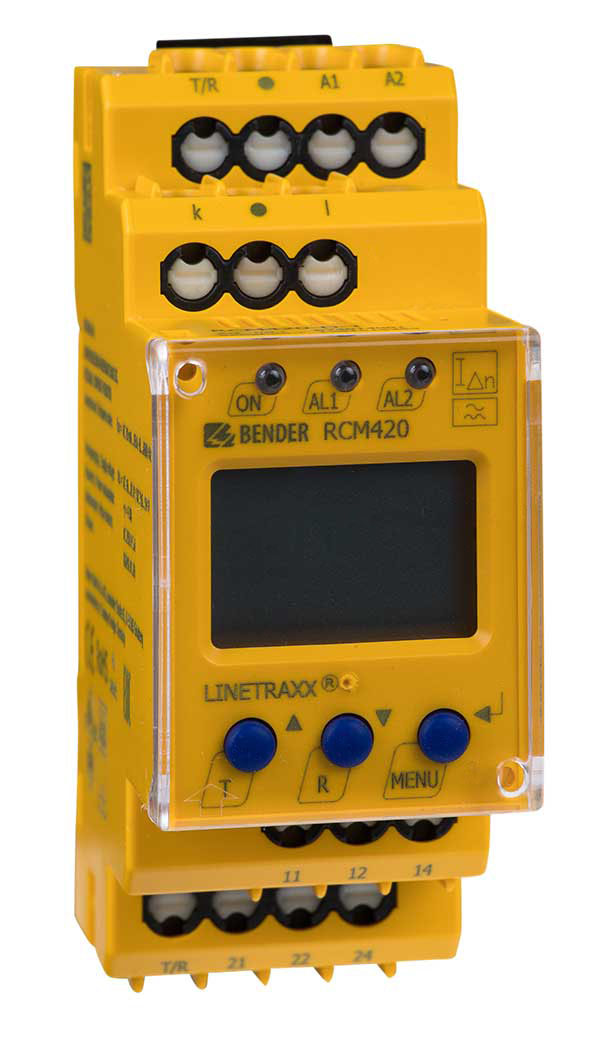
LINETRAXX® RCM420
A Type A residual current monitor measures AC and pulsating DC currents with a compatible external sensor. Separate thresholds distinguish prewarning from alarm.
An alarm relay does not automatically make the device an RCD or a verified MRCD protection chain.Explore the model and documents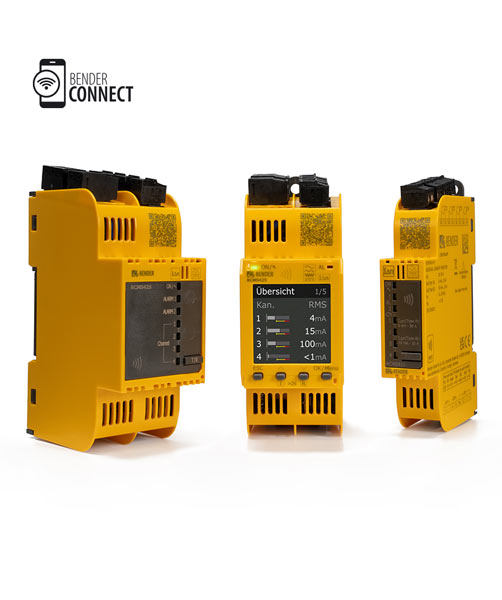
LINETRAXX® SmartDetect RCMS
Monitors different circuits across four separate channels, separating prewarning, main alarm and measurement information by channel. Modbus RTU transfers information to a supervisory system.
Type B/B+ AC/DC measurement requires a suitable sensor and function module B. This model's primary task is monitoring and notification.Explore the model and documents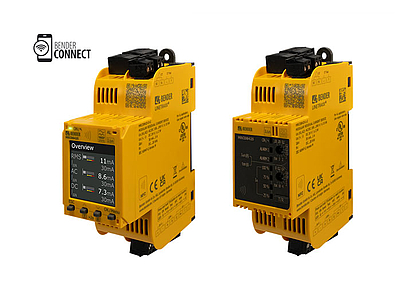
LINETRAXX® SmartDetect MRCDB425
AC/DC-sensitive MRCDB425 is used with a suitable measuring current transformer and circuit breaker in a modular residual current protection arrangement. Protective tripping differs from a simple RCM alarm.
Assessed with a suitable CTUB102–CTBC sensor and circuit breaker with an undervoltage release; it is not an independent load circuit breaker.Explore the model and documentsThe comparison explains different tasks. Required protection, distribution system arrangement and component combinations must also be verified using technical product documents. Product images belong to Bender.
Bender sources for these models
Bender technical explanations
This English summary is based on the Bender technical sources listed below.
- Bender — How does residual current monitoring work? ↗
- Bender — Product Overview: Residual Current Monitoring (2026) ↗
Sources checked: 2026-10-22. Diagrams belong to Bender; Turkish explanations summarised by ADEO Teknik.